True/false questions that are actually rigorous
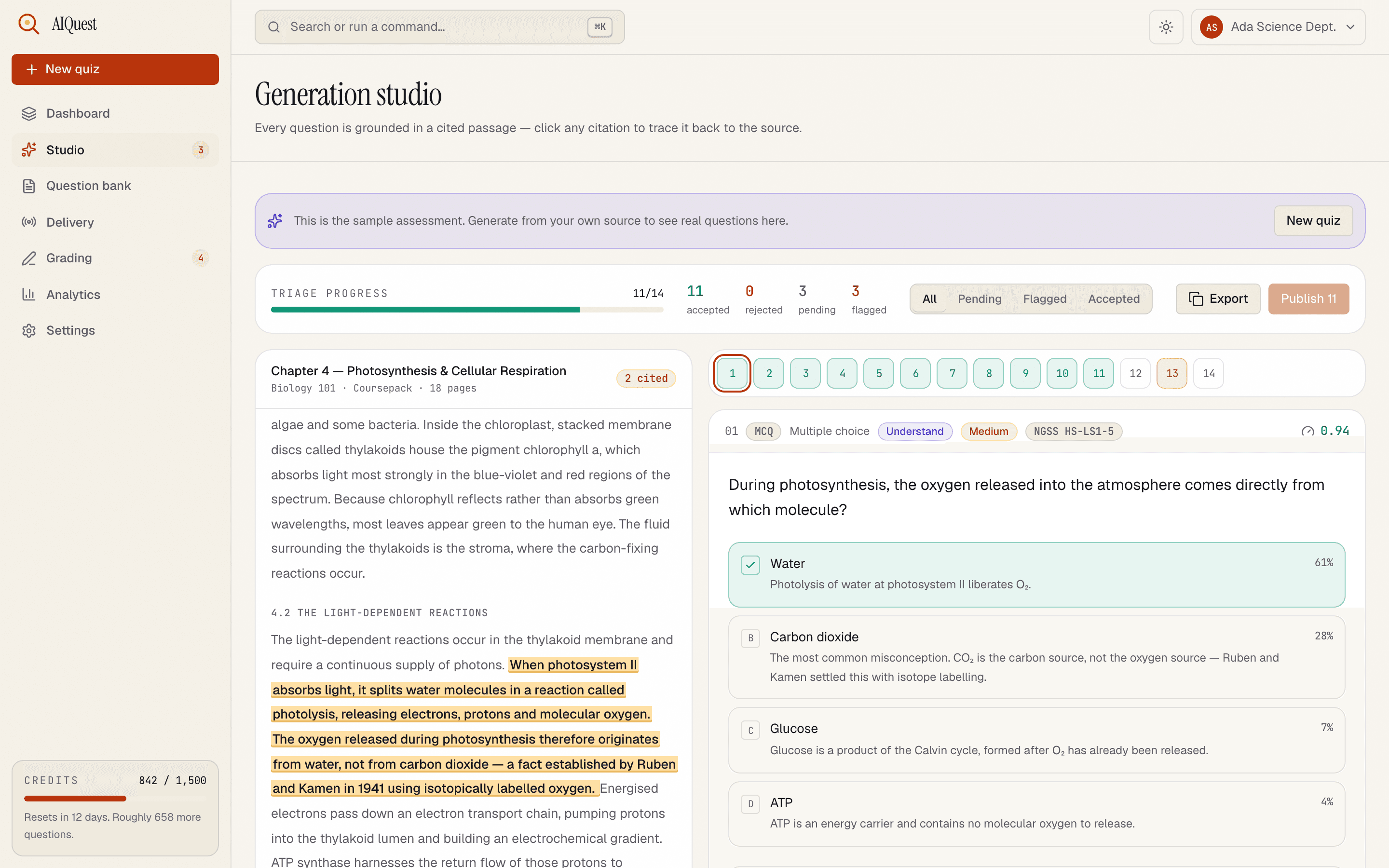
True/false questions have a deservedly mixed reputation: a 50% guess rate and a tendency toward trivia. But done properly they're fast to answer, fast to grade, and excellent for surfacing misconceptions at scale. The trick is rigour — and the fastest way to lose a true/false dispute is to have no evidence for your answer. This guide shows how to generate T/F items you can settle in seconds.
- ✓Weak T/F tests trivia; strong T/F targets a specific, testable proposition.
- ✓False statements should be plausibly false — derived from a real misconception, not a random negation.
- ✓Every item should be paired with the source sentence that makes it true or false.
- ✓Balance the count of true and false items so students can't game the ratio.
Why most true/false questions are bad
Two failure modes dominate. First, trivia: “The book was published in 1998” tests nothing worth knowing. Second, ambiguity: a statement that's true in one reading and false in another, so the “right” answer is really “agree with the writer.” Both evaporate when the item is tied to an explicit source sentence — the statement becomes a clean claim your material either supports or contradicts.
How QuizRoom builds a defensible T/F item
For a true item, QuizRoom asserts something the source states and links the confirming sentence. For a false item, it takes a real claim and alters it into a plausible misconception — then links the sentence it contradicts. A server-side check confirms that citation exists, so you never get a “false” statement with no counter-evidence behind it.
A statement only ships if its supporting or contradicting sentence is found in your source.
Generate rigorous true/false items
- 1Bring a source
Paste or upload your material — QuizRoom numbers every sentence so each statement has an anchor.
- 2Generate balanced T/F
Ask for true/false (mixed with other types if you like); you get a balanced set of true and false statements, each cited.
- 3Export or deliver
Send them into Moodle or Canvas, or publish a hosted, auto-scored quiz.
Add a “correct the false ones” instruction when you deliver. Students don't just guess — they have to identify the error and fix it, which pushes a recall item toward Understand and Apply. The citation is the answer key.
Balancing and reviewing the set
Two review habits make T/F sets fair. Keep the true/false ratio roughly even so “when in doubt, pick true” doesn't pay off. And read each false statement as a student would — if the alteration is so extreme nobody could believe it, it's testing reading speed, not understanding. QuizRoom's per-item citations make both checks a quick scan rather than a re-read of the source.
How are the false statements generated?
They're derived from your source and altered into plausible misconceptions, then paired with the exact sentence they contradict — never unverifiable trivia.
Can I mix true/false with other question types?
Yes — combine any of nine question types in a single run, so a quiz can open with T/F warm-ups and build to MCQs and short answer.
How do I resolve a student challenge on a T/F answer?
Open the item: the source sentence that makes it true or false is shown right there, so a dispute is settled by evidence in seconds.
Is true/false suitable for high-stakes exams?
Used carefully — balanced, non-trivial, and grounded — T/F works well for coverage checks. For high-stakes weighting, mix it with higher-order item types.
Generate cited true/false questions
Get balanced, defensible T/F items — each with the sentence that settles it — free with 60 credits.
Start free — 60 creditsPhD in educational measurement. Spent twelve years building high-stakes exams for universities and professional certification boards before joining QuizRoom to work on defensible AI-generated assessment.