Writing Bloom's taxonomy questions that stay grounded
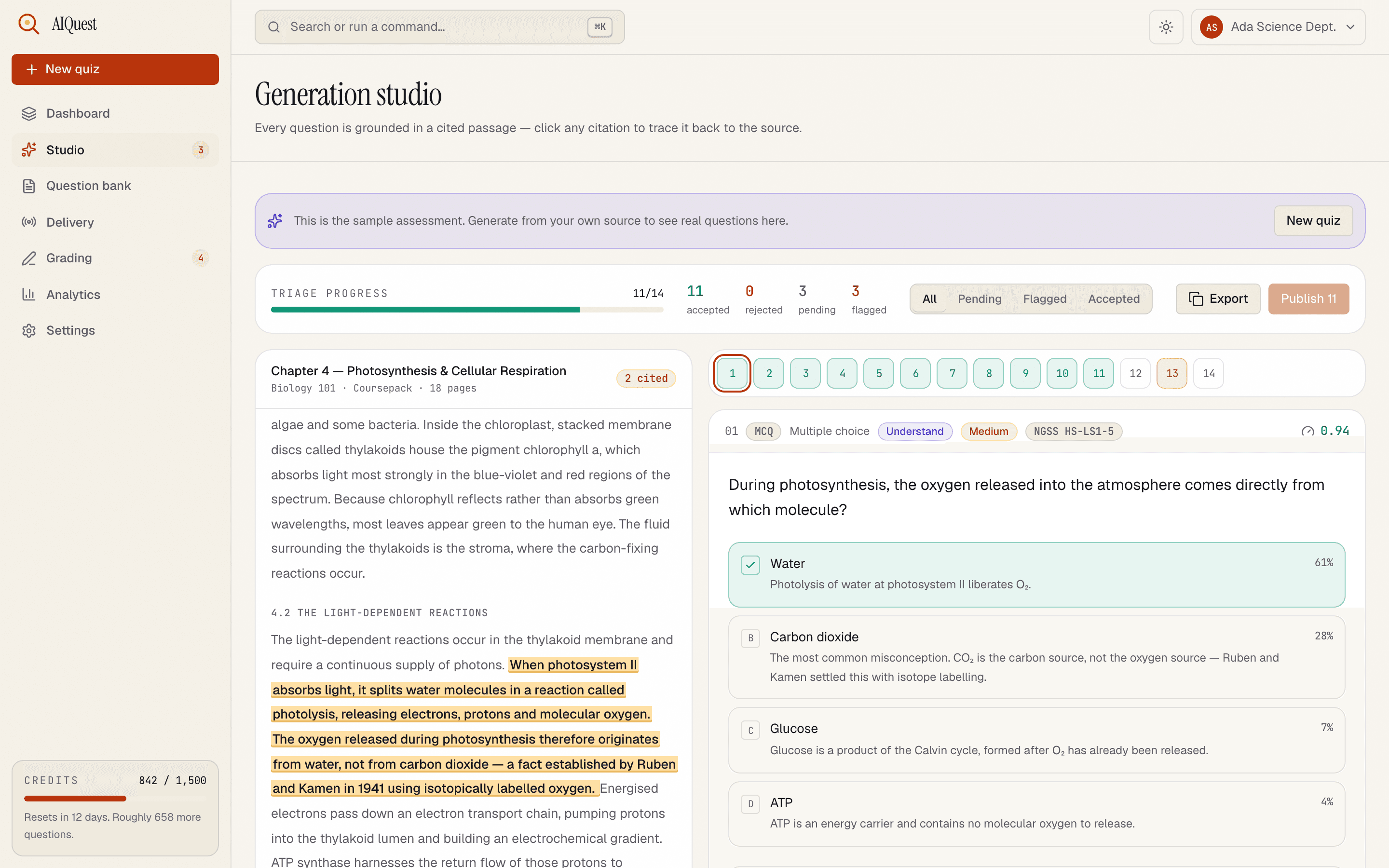
Bloom's taxonomy is the most-used and most-abused framework in assessment. Used well, it makes you write questions at the cognitive level you actually care about. Used badly, it becomes a verb-matching exercise that produces “higher-order” questions with no grounding — which is exactly where AI generators tend to go off the rails. This guide covers how to build a Bloom's-balanced quiz that stays honest.
- ✓Bloom's is about the cognitive demand of a question, not the verb in its stem.
- ✓Blueprint the mix before generating — decide the shape of the paper, then fill it.
- ✓Higher-order items (Analyze, Evaluate, Create) are where fabrication risk is highest — grounding matters most there.
- ✓Tag and rebalance: every QuizRoom item is labelled by level, so you can adjust the distribution after the fact.
The six levels, quickly
Bloom's revised taxonomy: foundational recall at the base, generative thinking at the top.
| Level | The student… | Sample verbs |
|---|---|---|
| Remember | recalls facts and terms | define, list, name, state |
| Understand | explains ideas in their own words | describe, summarise, classify |
| Apply | uses knowledge in a new situation | solve, compute, demonstrate |
| Analyze | breaks ideas into parts and relationships | compare, contrast, differentiate |
| Evaluate | judges using criteria and evidence | justify, critique, defend |
| Create | combines ideas into something new | design, propose, construct |
A stem can contain “analyse” and still only test recall (“Analyse which of these is the capital of France”). Bloom's level is set by what the student has to do, not the verb you paste in. Review for demand, not vocabulary.
Build a blueprint before you generate
A blueprint is just the intended distribution of questions across levels (and topics). Decide it first. A knowledge check might be 70% Remember/Understand; a final exam might push 40% into Apply and above. In QuizRoom you set these weights as dials, and generation targets them — instead of writing 30 questions and discovering afterward they're all recall.
- 1Set your weights
Weight Remember, Understand, Apply, Analyze, Evaluate and Create to match the assessment's purpose.
- 2Generate against the blueprint
Questions arrive matched to your distribution — each one tagged with its level and cited to the source.
- 3Rebalance and assemble
Filter by level, swap items, and export a paper whose cognitive shape is exactly what you planned.
How higher-order questions stay grounded
This is the crux. An Analyze or Evaluate item asks the student to reason across the material — which tempts a generator to invent a scenario the source never mentions. QuizRoom still requires the item to cite the sentences it builds on. So an “evaluate this claim” question points at the claim in your text and the evidence around it; it isn't free-floating. You get genuinely higher-order questions that are still defensible.
“Higher-order doesn't mean unmoored. The best Analyze questions are the ones where you can point at the two sentences the student has to reconcile.”
— Priya Nair, Learning Scientist
Common Bloom's mistakes to avoid
- ●Top-heavy papers — all Analyze/Create, no foundation, so weak students score zero and you learn nothing.
- ●Mislabelling recall as application — dressing up a definition in a word problem that requires no new reasoning.
- ●Ignoring topic coverage — a perfect level-mix that only touches half the syllabus.
- ●Skipping review of higher-order items — these need the most human judgement, not the least.
Can QuizRoom really target specific Bloom's levels?
Yes. You set a weighted mix across all six levels before generating, and each question is tagged with its level so you can verify and rebalance the distribution afterward.
Are the higher-order questions actually grounded?
They are — even Analyze, Evaluate and Create items must cite the source sentences they build on, so they're defensible rather than invented.
Can I combine a Bloom's mix with a difficulty mix?
Yes. Cognitive level and easy/medium/hard difficulty are separate dials, so you can, for example, ask for hard Understand questions or easy Apply ones.
Does this work for any subject?
Yes. Bloom's is subject-agnostic, and because questions are grounded in your specific source, the framework applies whether you teach history, chemistry or compliance.
Generate a Bloom's-balanced quiz
Set your cognitive-level mix and get grounded questions at every level — free with 60 credits.
Start free — 60 creditsInstructional designer focused on retrieval practice and item quality. Writes QuizRoom's guidance on distractor design, Bloom's alignment and question validity.