How to generate matching quizzes that test more than memory
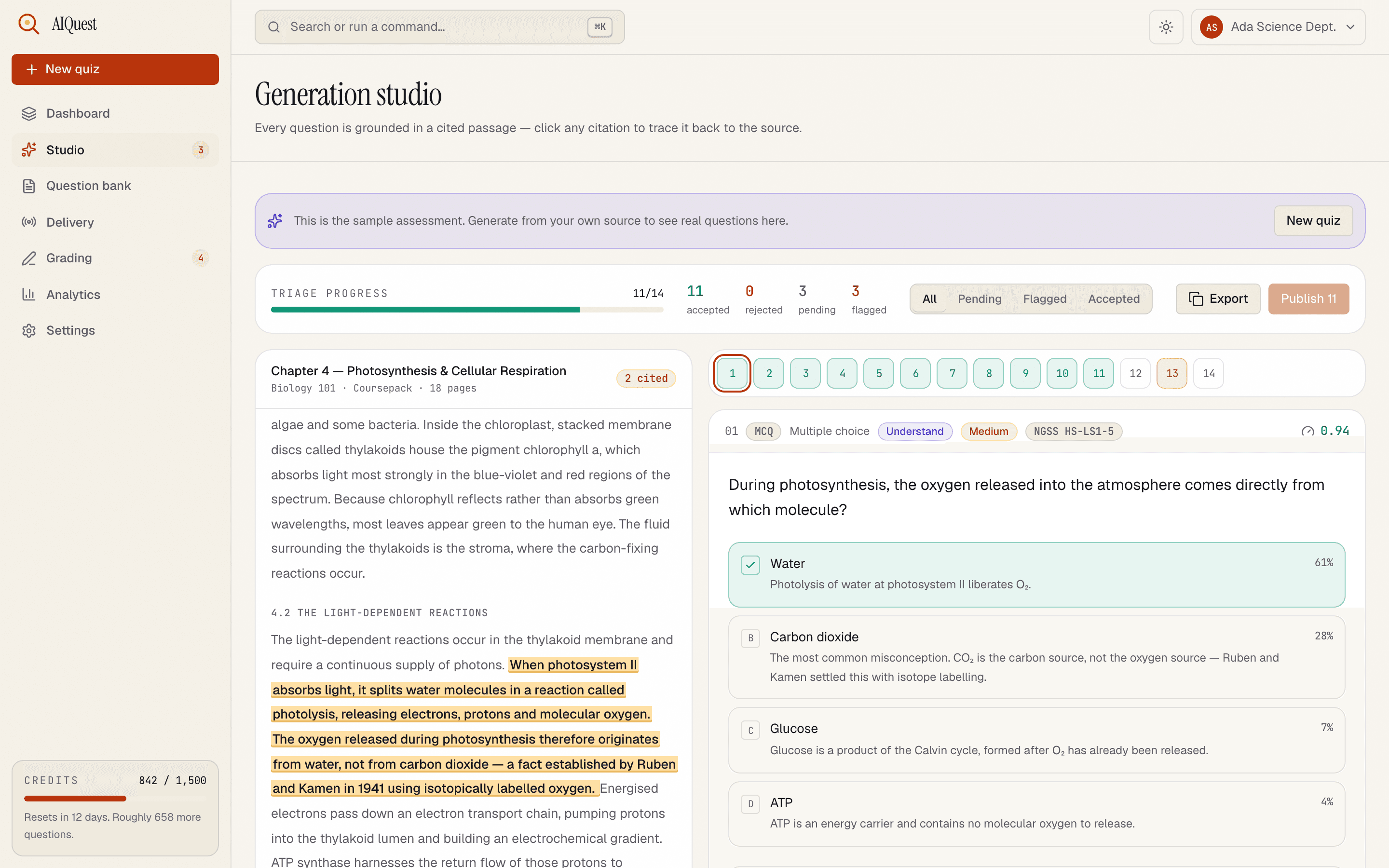
Matching questions are the most efficient way to test a web of related facts — terms and definitions, causes and effects, people and contributions — in a single compact item. They are also the easiest to write badly: get the balance wrong and a student can solve the whole set by elimination without knowing most of the pairs. This guide covers generating matching quizzes that actually test the relationships, with every pair traceable to your source.
- ✓Matching tests relationships, not recall of isolated facts — pick content where the pairing itself is the learning.
- ✓Uneven columns (more options than prompts) defeat the solve-by-elimination shortcut.
- ✓Every pair should trace to the sentence that establishes it, so a disputed match is settled by evidence.
- ✓Keep each set to one coherent theme — mixing unrelated pairs makes elimination trivial.
What makes a matching item good
A strong matching set has a single, consistent basis for pairing — every prompt relates to its answer in the same way (term→definition, or event→year, but not both in one set). Homogeneity is what forces genuine knowledge: if the pairs are mixed, a student pairs the obvious ones and elimination hands them the rest.
- ●One relationship per set — all term→definition, or all cause→effect, never a mix.
- ●An uneven column — offer a few more answers than prompts so the last pair isn't free.
- ●Short, parallel options — answers of similar length and grammar, so length isn't a tell.
- ●Ungrounded pairs — the failure mode a citation catches: a plausible-looking pairing your source never actually makes.
How QuizRoom generates and cites each pair
QuizRoom numbers every sentence in your source before it generates. Each pair in a matching item must point back to the sentence that establishes the relationship — if the source never links a term to its definition, that pair can't be generated. A server-side check drops any item it can't ground, so you never publish a matching set built on an invented connection.
- 1Bring a source rich in relationships
A glossary, a chapter that defines terms, or a timeline works best — the pairing has to exist in the text to be cited.
- 2Choose Matching and a count
Pick matching (alone or mixed with other types) and how many pairs. Questions stream in, each grounded in a sentence.
- 3Review and deliver
Confirm each pair against its citation, then publish a hosted quiz that scores itself, or export to your LMS.
When you deliver, keep the answer bank a little longer than the prompt list. Two or three extra plausible answers remove the “last one is free” shortcut and turn a recall exercise into a real discrimination task.
Can matching questions be mixed with other types?
Yes — combine matching with MCQ, true/false, short answer and more in a single run, so a quiz can move from warm-up pairs to higher-order items.
How are the pairs kept accurate?
Every pair is grounded in a source sentence and rejected if it can't be cited, so the connections come from your material — not from the model's general knowledge.
What can I match?
Anything your source relates: terms and definitions, events and dates, causes and effects, authors and works, structures and functions.
How do I export a matching quiz?
Publish a hosted, auto-scored link, or export to QTI, Moodle XML, GIFT and more — 18 formats in total.
Generate a cited matching quiz
Turn a glossary or chapter into clean, defensible pairs — each traced to the sentence that makes it true. Free with 60 credits.
Start free — 60 creditsInstructional designer focused on retrieval practice and item quality. Writes QuizRoom's guidance on distractor design, Bloom's alignment and question validity.